


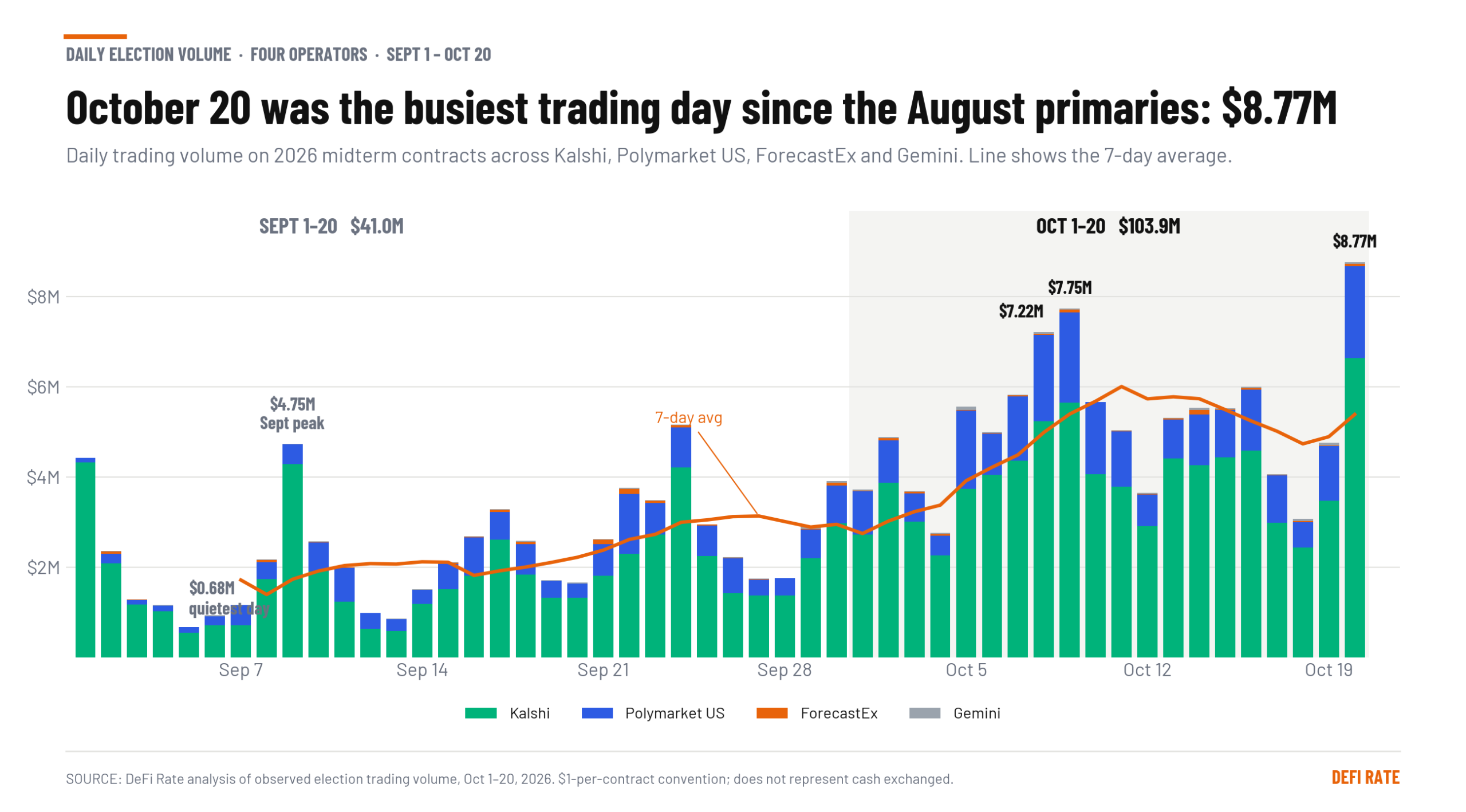
Trading volume on the 2026 midterm elections reached $103.87 million across Kalshi, Polymarket US, ForecastEx and Gemini during the first 20 days of October, up from approximately $41 million over the same period in September.
But the surge wasn’t spread evenly across the November ballot.
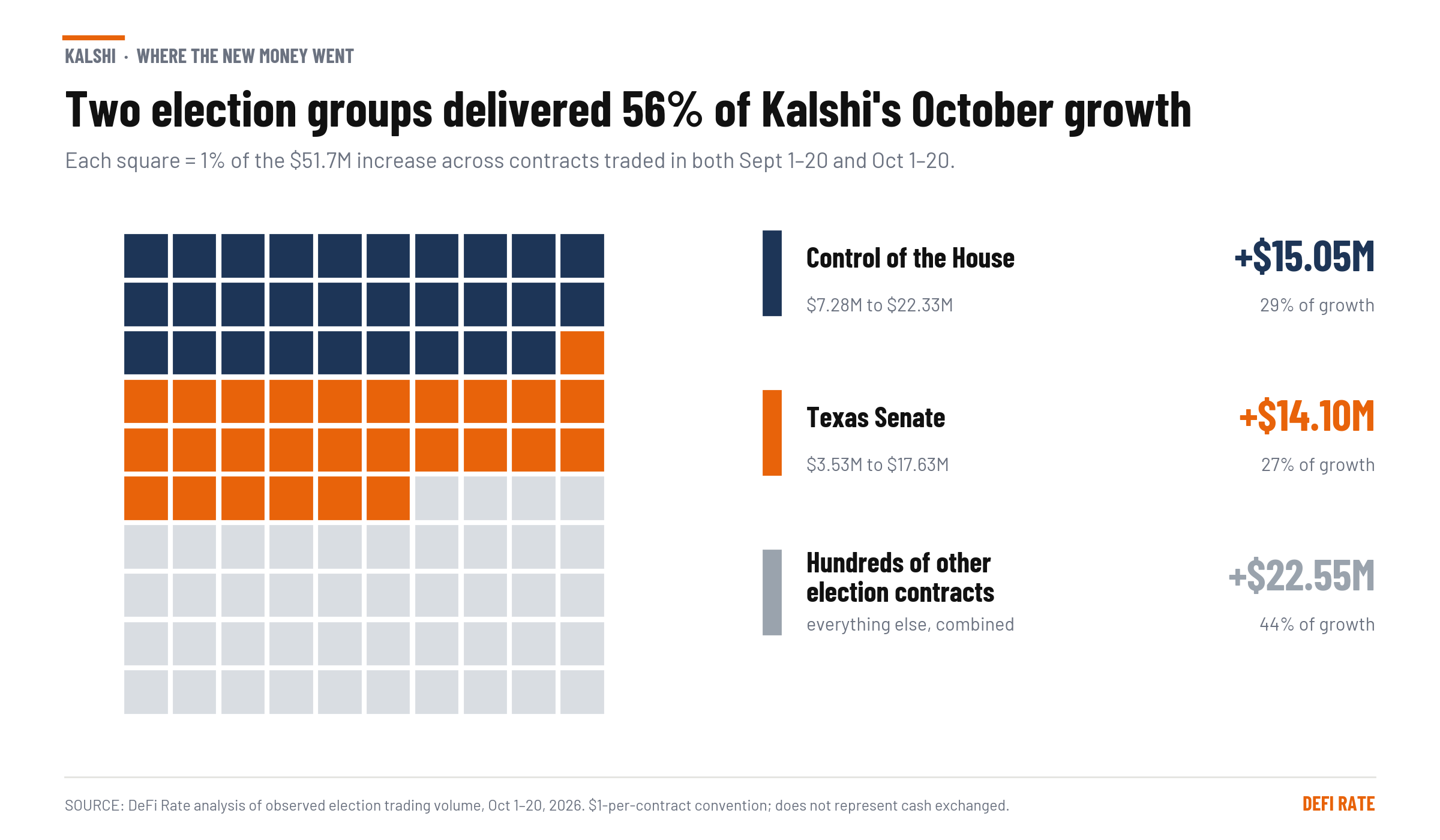
The Texas Senate race and the battle for control of the House have emerged as the two biggest draws, generating nearly $49 million in October trading volume across the four operators.
On Kalshi, those two election groups accounted for $29.2 million of the $51.7 million increase recorded across contracts continuously observed in both September and October. That’s more than half of the growth in the comparable group, with hundreds of other election products making up the remainder.
Polymarket US is seeing a similar concentration. Texas Senate and national House-control contracts recorded a combined $7.7 million in October volume, accounting for roughly a third of the operator’s $23.7 million in election trading during the period.
With November 3 approaching, the latest figures show that a handful of races are driving prediction market trading volume, even as operators offer contracts covering elections across the country.
Texas Senate emerges as October’s biggest growth market
Texas Senate generated $17.94 million in October trading volume on Kalshi, compared with $5.96 million during the full month of September. The first 20 days of October have already produced three times September’s entire trading volume for the race.
The jump is also evident when comparing equal-length periods. Kalshi’s continuously observed Texas Senate contracts went from $3.53 million during September 1–20 to $17.63 million during October 1–20.
On Polymarket US, Texas Senate reached another $3.69 million in October volume, compared with $1.11 million during September.
Combined with smaller amounts recorded on Gemini and ForecastEx, Texas Senate generated approximately $21.7 million in trading volume across the four operators during October 1–20.
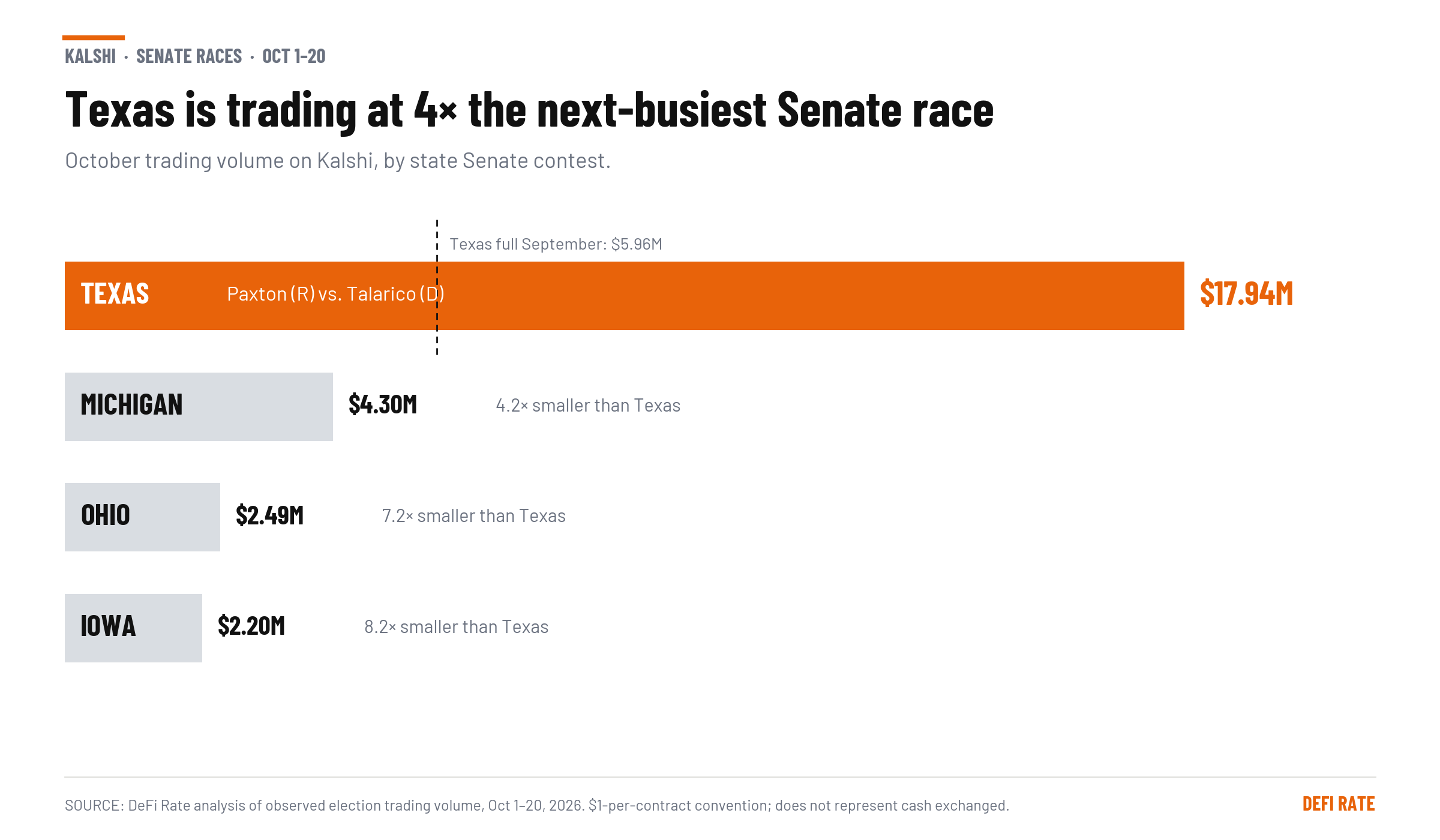
The race between Republican Ken Paxton and Democrat James Talarico has attracted far more activity than most other individual Senate contests. On Kalshi, Michigan Senate generated $4.30 million in October volume, while Ohio recorded $2.49 million and Iowa $2.20 million.
The Texas market has also grown faster than several of those contests. Its increase among continuously observed Kalshi contracts exceeded the combined increases for Michigan, Ohio, Iowa and South Carolina Senate contracts.
Texas is not merely one of the largest midterm election markets by historical volume. It is contributing more new trading activity in October than any other individual state election identified in the data.
Control of the House attracts another $27 million
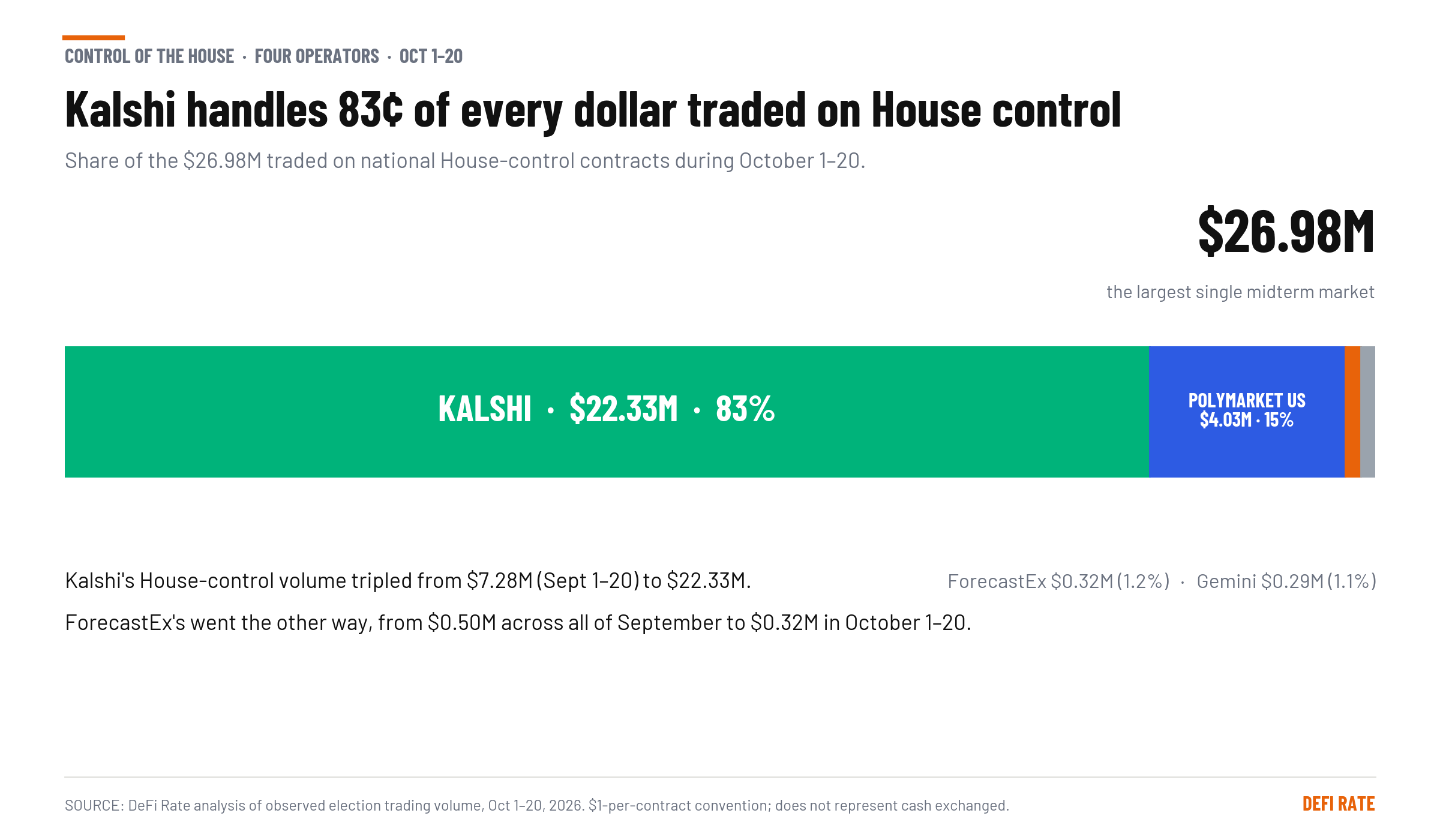
The national House-control market generated $26.98 million across the four operators during the first 20 days of October, putting it ahead of any individual state election.
Kalshi accounted for $22.33 million, while Polymarket US recorded $4.03 million. ForecastEx and Gemini added smaller amounts.
Kalshi’s House-control contracts generated $7.28 million during September 1–20 before rising to $22.33 million during October 1–20. That represents an additional $15.05 million in trading on the same continuously observed contracts.
Together with Texas Senate, the House-control market has become a major source of the October increase.
The activity also shows the difference between trading on a single race and taking a position on the national result. House-control contracts allow traders to speculate on which party will hold the chamber after all 435 districts have voted, rather than requiring positions in individual congressional contests.
House control is particularly prominent on Polymarket US, accounting for approximately 17% of the operator’s October election volume. On ForecastEx, more than half of October election volume came from the national House-control group, although that market’s overall activity declined compared with September.
The national Senate-control market is smaller but growing. It generated $5.05 million on Kalshi and $1.41 million on Polymarket US during October 1–20.
Iowa’s governor and Senate races gain ground
Outside Texas and national congressional-control markets, Iowa stands out for growth in October trading.
Polymarket US recorded $1.44 million on Iowa’s gubernatorial election in the first 20 days of October, compared with $296,475 in all of September.
The increase was particularly pronounced among continuously observed contracts, where trading climbed from approximately $30,864 during September 1–20 to $1.44 million during October 1–20.
Iowa’s Senate race is drawing more attention. Polymarket US recorded $1.28 million in October volume, while Kalshi generated another $2.20 million.
The two Iowa elections have now generated nearly $5 million in October trading volume across Kalshi and Polymarket US alone.
They remain substantially smaller than the Texas Senate and the national House-control market, but their growth shows that the increase isn’t restricted to the two biggest election groups.
Not every election market is growing
October’s gains have not been uniform, even among established election products.
Kalshi’s Ohio Senate market generated $2.49 million in the first 20 days of October, below the $2.71 million recorded across the full month of September. Its continuously observed contracts nevertheless more than doubled over the comparable 20-day September period.
Other markets showed outright declines. Polymarket US recorded $695,028 on California’s gubernatorial election in October, up from $1.06 million in September, while ForecastEx’s national House-control volume fell from $500,942 in September to $320,951 in October.
These differences are significant because the industry’s overall growth can mask the direction of individual election markets. The October increase was substantial, but not every contest is attracting volume at the same pace.
The broader figures remain heavily weighted toward Kalshi. The operator generated $79 million, representing approximately 76% of the four-operator October total, while Polymarket US accounted for $23.72 million.
Polymarket US, however, posted the larger percentage increase, with election trading volume up 203% from the first 20 days of September. Kalshi recorded a 142% increase.
The next reporting period will show whether the latest growth continues to concentrate in Texas Senate and congressional-control contracts or begins spreading more widely across competitive elections as November 3 approaches.
Methodology: DeFi Rate analyzed observed election trading volume from January 1 through October 20, 2026. All volume is reported using a $1-per-contract or reported-unit convention and does not represent cash exchanged. October totals cover October 1-20. Percentage growth comparisons use September 1-20 against October 1-20, while full-September comparisons are identified separately. Matched-contract comparisons include only contracts continuously observed in both periods.




