


Key takeaways
- HYPE rose 8.67% in 24 hours to $65.875, well ahead of Bitcoin (+1.6%) and Ethereum (+1.38%).
- Whale Radar’s tracked whales held $120.61 million in shorts against $50.48 million in longs, roughly 70% of their exposure.
- Open interest rose alongside price: up 17.6% per Whale Radar and 12.35% to $2.76 billion per CoinGlass.
- Other trackers show a near-neutral or even net-long picture, so whale sentiment depends on which wallets are counted.
- HYPE joins the index tracked by Franklin Templeton’s EZPZ ETF on December 1.
Hyperliquid price climbed nearly 9% over 24 hours on Friday, reaching $65.875, despite more than $120 million in short positions held by one group of tracked whales. The recovery comes just days before Franklin Templeton is expected to add HYPE to its cryptocurrency index ETF. The planned inclusion follows the May debut of dedicated spot Hyperliquid ETFs, whose early performance Bitcoinist previously covered.
Bitcoin and Ethereum gained just 1.6% and 1.38%, respectively, over the same period, leaving HYPE comfortably ahead of both cryptocurrencies.
The more interesting development, however, is happening in Hyperliquid’s derivatives market, where large traders appear far less convinced about the token’s next move.
Hyperliquid Traders Take On More Exposure During The Rally
According to Whale Radar’s November 27 market report, published at 12:00 UTC, HYPE gained 8.67% over 24 hours, while open interest increased by 17.6%.
The platform’s tracked whales held $120.61 million in short positions compared with $50.48 million in longs, meaning roughly 70% of the group’s exposure was positioned against the token.
A separate reading from CoinGlass shortly before the report showed total HYPE futures open interest across monitored exchanges reaching $2.76 billion, up 12.35% over 24 hours.
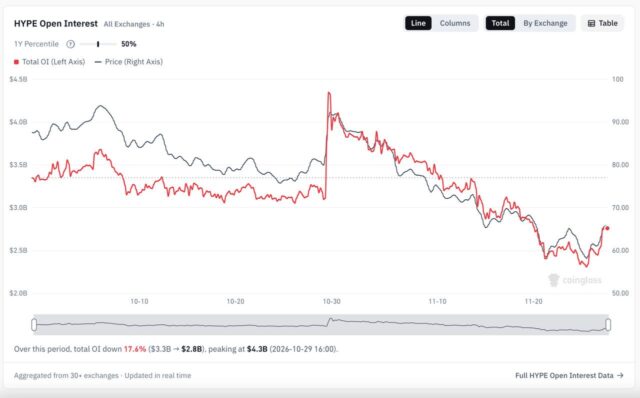
Rising prices alongside rising open interest make for an interesting combination. More money is tied up in outstanding derivatives positions, although part of the increase in dollar-denominated exposure can come from the appreciation of HYPE itself.
It also means the recovery cannot simply be explained by looking at traders closing their shorts.
Are Hyperliquid Whales Actually Bearish?
Not all of them.
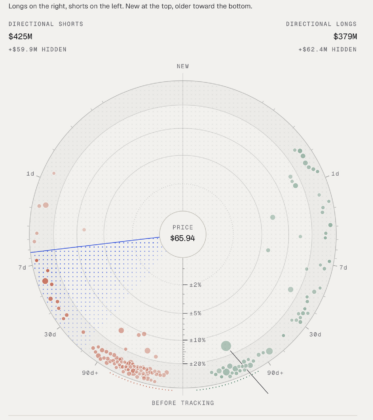
An earlier snapshot from a separate whale tracking dashboard showed approximately $491 million in HYPE shorts against $448 million in longs. That dataset, which covers positions of at least $1 million held by monitored accounts, was considerably more balanced.
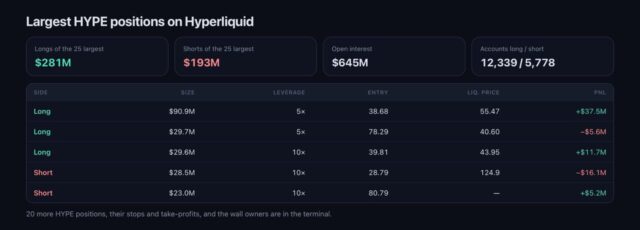
Another tracker, Liqwall, recorded $287 million in longs and $195 million in shorts across the 25 largest HYPE positions on Hyperliquid earlier on Friday.
| Tracker | Longs | Shorts | Short share |
|---|---|---|---|
| Whale Radar report (tracked whales) | $50.48M | $120.61M | ~70% |
| Whale dashboard (positions of $1M+) | $448M | $491M | ~52% |
| Liqwall (top 25 positions) | $287M | $195M | ~40% |
HYPE whale positioning by tracker on November 27. Short share is shorts as a percentage of combined long and short exposure. Source: Whale Radar, whale tracking dashboard, Liqwall; Bitcoinist calculations.
The difference matters. Depending on which wallets are included, the same market can look heavily bearish, almost neutral or even bullish.
There is also no way to tell from an isolated short position whether its owner is genuinely bearish on HYPE or simply protecting a much larger spot investment elsewhere.
A continuation of the rally could put pressure on leveraged short sellers, potentially forcing some to buy back their positions. But the existence of large shorts alone is not enough to call a short squeeze.
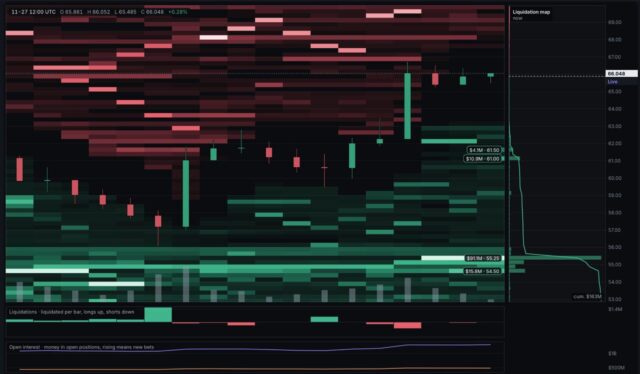
The risk runs both ways. Blockmetric’s liquidation heatmap shows approximately $91.1 million in potential liquidation exposure around $55.25, highlighting the vulnerability of leveraged long positions if the rally reverses.
Franklin Templeton Is About To Add HYPE To Its Crypto ETF
While derivatives traders remain divided, another source of potential demand is approaching.
A prospectus supplement filed with the US Securities and Exchange Commission, dated November 25, disclosed that Hyperliquid would be added to the underlying index tracked by the Franklin Crypto Index ETF (EZPZ), effective December 1.
The index provider, CF Benchmarks, had originally announced the change on November 16.

What makes Franklin Templeton’s addition different is that investors in a diversified cryptocurrency fund will gain exposure to HYPE without having to specifically select the token or a dedicated Hyperliquid ETF.
Still, inclusion in an index is not the same as an immediate wave of institutional buying. The size of the allocation will determine how much demand the rebalancing actually creates.
For HYPE traders, December 1 offers a concrete event to watch. Until then, the growing derivatives exposure makes Friday’s recovery particularly sensitive to another sharp move in either direction.

Editorial Process for bitcoinist is centered on delivering thoroughly researched, accurate, and unbiased content. We uphold strict sourcing standards, and each page undergoes diligent review by our team of top technology experts and seasoned editors. This process ensures the integrity, relevance, and value of our content for our readers.




